Let's cut to the chase: figuring out crypto taxes feels like trying to read a map in a language you don't speak, especially when you're dealing with rules from different countries. One wrong turn and you could be facing penalties, audits, or a massive unexpected bill. I've seen it happen to a friend in Berlin who got a four-figure fine for missing a single DeFi staking reward. The core problem isn't just that rules are complex—it's that they're wildly inconsistent across borders. This guide is your translation tool. We'll walk through the specific tax frameworks in major jurisdictions, highlight the traps most guides miss, and give you a practical action plan. Forget generic advice; this is about what you actually need to know based on where you live or trade.
What You'll Learn in This Guide
The Foundational Rules: Capital Gains vs. Income
Before we dive into specific countries, you need to understand the two main ways tax authorities look at your crypto. Almost every system uses a mix of these.
Capital Gains Tax (CGT): This applies when you sell, trade, or spend cryptocurrency for a profit. If you buy 1 Bitcoin for $30,000 and later sell it for $50,000, you have a $20,000 capital gain. That gain is taxable. The rate often depends on how long you held the asset (short-term vs. long-term).
Income Tax: This treats crypto as regular earnings. It applies when you receive crypto as payment. Common examples include:
- Earning crypto as a salary or for freelance work.
- Mining or staking rewards (this is a huge point of variation by country).
- Airdrops and hard forks (again, treated differently everywhere).
- Interest earned from crypto lending platforms.
Here's the kicker most beginners miss: a single transaction can trigger both taxes. Say you earn 0.1 ETH from staking (income tax event). A year later, you sell that 0.1 ETH for a higher fiat price (capital gains event on the sale). You owe tax twice on the same coins. Failing to track the "cost basis" of that earned ETH is a classic, expensive error.
Crypto Tax by Country: A Detailed Breakdown
This is where things get real. Let's look at how major economies handle this. The table below gives you the high-level view, but the devil is in the details that follow.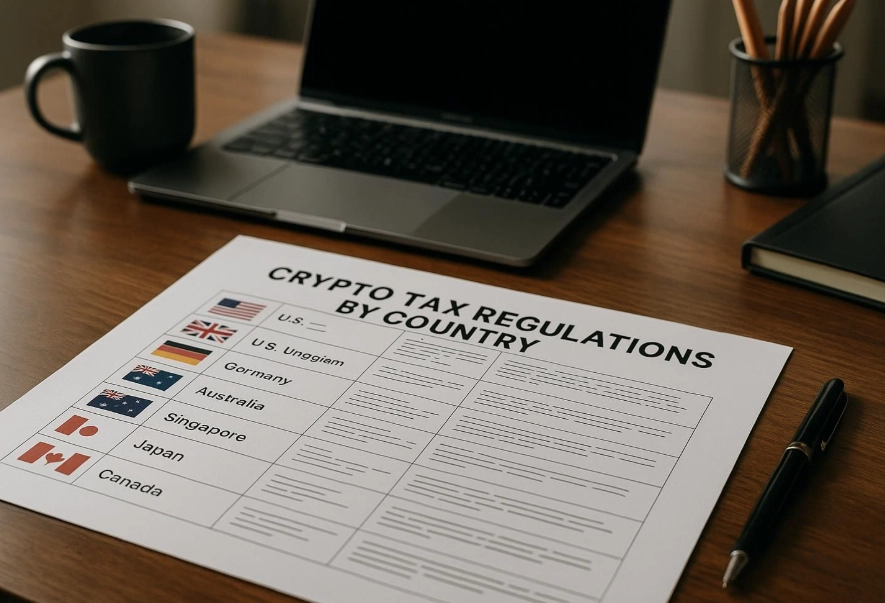
| Country | Tax Classification | Capital Gains Rate | Income Tax Rate | Key Nuance |
|---|---|---|---|---|
| United States | Property (by the IRS) | Up to 37% (Short-term), 0-20% (Long-term) | Up to 37% (Ordinary Income) | Extremely broad definition of taxable events; staking rewards taxed as income at receipt. |
| United Kingdom | Capital Asset | 10-20% (CGT Allowance applies) | 20-45% (Income Tax) | HMRC has detailed crypto manuals; DeFi lending may not be a disposal event. |
| Germany | Private Money / Other Asset | 0% after 1-year holding period | Personal Income Tax Rate | Holding period is key; staking rewards may be tax-free after 10 years. |
| Singapore | Not Legal Tender | 0% (for individuals as investment) | 0% (for long-term investing) | Effectively zero capital gains tax. Tax applies if trading is a business. |
| Japan | Miscellaneous Income | Up to 55% (Progressive Income Tax) | Up to 55% (Same as gains) |
United States: The Complex Benchmark
The IRS treats crypto as property. That means every time you trade one coin for another, it's a taxable event. Swapping ETH for USDC? That's a sale of ETH. Using Bitcoin to buy an NFT? That's a sale of Bitcoin. This creates a massive record-keeping burden. The IRS guidance (found in Notice 2014-21 and subsequent updates) is clear but demanding. Staking rewards are taxed as ordinary income at their value when you gain control over them. The recent Jarrett case challenged this, but until the law is clear, assuming income treatment is the safe bet.
United Kingdom: A Surprisingly Pragmatic Approach
Her Majesty's Revenue and Customs (HMRC) has one of the most detailed crypto manuals of any tax agency. Like the US, buying and selling crypto for fiat is a CGT event. However, UK rules can be more forgiving for DeFi. According to HMRC's manual, simply transferring crypto to a lending protocol to earn interest might not be a "disposal" for CGT if you retain full ownership—a significant difference from some interpretations. Always check the latest HMRC crypto manual for updates.
Germany: The Hodler's Paradise (With Conditions)
Germany's rule is famous: if you hold Bitcoin or other crypto for more than one year, the capital gains from selling it are completely tax-free. This is a dream for long-term investors. But the rules tighten if you're active. If you sell within the one-year period, gains are tax-free only up to a €600 annual allowance; beyond that, they're added to your personal income. For staking rewards, the holding period is a lengthy ten years to become tax-free. This nuance trips up many new German crypto users who think all rewards are instantly tax-free.
Singapore & Japan: Two Extremes
Singapore has no formal capital gains tax. For an individual investor, buying and selling crypto is not taxed. However, if the Inland Revenue Authority of Singapore (IRAS) deems your activity to be a trade or business (high frequency, organized effort), profits become taxable business income. It's a principle-based test.
Japan stands in stark contrast. The National Tax Agency treats crypto gains as "Miscellaneous Income," which gets added to your total income and taxed at progressive rates that can exceed 55%. Every trade between cryptocurrencies is a taxable event, and you must track the JPY value at each transaction. The compliance load is heavy.
The Tough Stuff: DeFi, Staking, and NFT Taxes
Traditional tax codes weren't built for smart contracts. Here's where even experienced investors get lost.
DeFi Yield Farming & Liquidity Pools: When you provide liquidity, you usually receive LP tokens. In many countries (like the US), depositing your crypto into the pool is a disposal (CGT event). You then earn fees, which are likely taxable as income as you accrue the right to them. When you withdraw, another disposal event occurs for the LP tokens. It's a tax nightmare without specialized software.
NFTs: Buying an NFT with fiat is just an acquisition. Buying an NFT with crypto is a disposal of that crypto (CGT event). If you later sell the NFT for a profit, that's a capital gain. If you're an artist minting and selling your own NFTs, that's ordinary business income. The complexity? Determining the cost basis for an NFT you created yourself can be ambiguous.
Most tax authorities are still playing catch-up here. The lack of clear guidance means you must apply first principles: track every on-chain action, record fair market values in your local currency, and be prepared to justify your treatment.
Your Action Plan: How to Stay Compliant
Feeling overwhelmed? Here's a concrete, step-by-step process you can start today.
Step 1: Determine Your Tax Residency. This dictates the rulebook. Don't guess. Look at the statutory residency tests for the country you live in.
Step 2: Export All Your Transaction History. Go to every exchange (Coinbase, Binance, Kraken), DeFi platform, and wallet you've used. Download CSV files for all transactions for the tax year. Include dates, amounts, and transaction IDs.
Step 3: Use a Crypto Tax Software. For anything beyond simple buying and holding on one exchange, manual calculation is a recipe for error. Tools like Koinly, CoinTracker, or Accointing can connect via API, import your CSVs, and automatically classify transactions based on your country's rules. They calculate your gains, losses, and income. The fee is worth the sanity and accuracy.
Step 4: Identify Gaps & Estimate. Did you use a decentralized exchange with no KYC? Did you lose records from a wallet? The software will flag missing cost basis data. For missing data, you may need to make a reasonable estimate and document your methodology. Hiding the transaction is far riskier than making a good-faith estimate.
Step 5: File and Report. Use the reports from your tax software to fill out your tax return. In the US, this is Form 8949 and Schedule D. In the UK, you report capital gains via your Self Assessment tax return. Don't forget to declare any crypto income on the income sections.
I made the mistake in 2017 of trying to do it all in a spreadsheet. After 50 hours of work and still being unsure, I switched to software. The time and stress saved were immense.
Reader Comments