Let's talk about the USDC price. If you're here, you probably already know it's supposed to be $1. That's the whole point of a stablecoin like USD Coin (USDC). But it's not magic. That price stability is a deliberate, engineered outcome backed by real-world assets and complex market mechanics. I've seen too many newcomers treat it like a digital dollar bill that can't possibly waver, only to get spooked when they see a quote of $0.9995 on an exchange. The reality is more nuanced, and understanding those nuances is what separates savvy crypto users from the rest. This guide will break down exactly how the USDC price works, where to track it, why it might move a fraction of a cent, and how you can actually use that knowledge to your advantage.
What's Inside?
- How the USDC Price Stays at $1: The Reserve System
- Where to Check the USDC Price: Top Platforms Compared
- Why the USDC Price Might Fluctuate (Even Slightly)
- How to Trade USDC: Strategies for Beginners and Pros
- USDC vs. USDT: A Price Stability Comparison
- The Future of USDC Price: Challenges and Innovations
- Your USDC Price Questions Answered
How the USDC Price Stays at $1: The Reserve System
The $1 peg isn't a promise; it's a function of collateral. For every single USDC token in circulation, Centre Consortium (the entity behind USDC, founded by Circle and Coinbase) claims to hold at least $1 worth of assets in reserve. This is the core mechanism.
These reserves aren't just cash sitting in a vault. They're a mix of what they call "cash and cash equivalents." According to their monthly attestation reports conducted by independent accounting firms like Grant Thornton, this primarily includes:
- U.S. Treasury bonds (Short-dated, very liquid).
- Commercial paper from highly-rated corporations.
- Certificates of deposit (CDs).
- Actual U.S. dollars in federally insured bank accounts.
The monthly attestation is a big deal. It's more transparent than many competitors who only do quarterly reports. You can go to Circle's official website right now and download the latest PDF to see the breakdown. This transparency is a key reason institutions and many DeFi protocols prefer USDC.
Here's the non-consensus bit everyone misses: The peg is maintained by arbitrageurs, not just by Circle. If USDC trades at $0.998 on an exchange, a large trader can buy it cheaply, redeem it directly with Circle for a full $1 (a process available to eligible entities), and pocket the difference. This buying pressure pushes the price back up. The reverse happens if it goes above $1. The system relies on this market force being efficient and accessible. If redemption gates were ever closed, the peg would be in immediate danger.
Where to Check the USDC Price: Top Platforms Compared
You don't check the "USDC price" in one universal place. You check the trading price on specific venues, and they can differ by tiny fractions. Here’s where to look and why you'd choose each.
| Platform Type | Best For | Price You See | Key Consideration |
|---|---|---|---|
| Aggregators (CoinMarketCap, CoinGecko) | Getting a global, volume-weighted average. A quick sanity check. | An aggregate price from multiple exchanges. | Useful for a macro view, but not the price you can actually trade at. |
| Centralized Exchanges (Coinbase, Binance, Kraken) | Actual trading and conversions. Seeing the live order book. | The specific buy/sell price on that exchange's USDC/USD or USDC/USDT pair. | Prices can vary between exchanges due to liquidity differences. Coinbase often has it closest to $1.00 due to easy fiat on/off ramps. |
| DeFi Wallets (MetaMask, Phantom) | Checking the value of USDC in your wallet for spending or DeFi use. | Usually pulls from an oracle like Chainlink, which aggregates exchange data. | This is the "accounting" price for your holdings. Crucial for DeFi collateral calculations. |
| Circle's Official Redemption | The canonical $1.00 value for qualified businesses. | Exactly $1.00 for creation and redemption. | Not a public trading price. This is the anchor that makes the arbitrage mechanism work. |
My go-to for a real trading signal is the order book on a major exchange like Kraken or Coinbase Pro. Look at the bid (buy) and ask (sell) spread. If the spread is tight (e.g., $0.9999 / $1.0001), liquidity is high and the peg is strong. A wide spread tells you something is off.
Why the USDC Price Might Fluctuate (Even Slightly)
It's rarely about the reserves. The daily micro-fluctuations you see on exchanges are about market mechanics.
Supply and Demand Imbalances
During a crypto market crash, everyone flees to stablecoins. Demand for USDC can temporarily outstrip the ease of minting new tokens, pushing its price above $1 (e.g., $1.005). Conversely, if there's a mass exodus from crypto into pure fiat, selling pressure can push it slightly below.
Exchange-Specific Liquidity
A smaller exchange with shallow order books will have a harder time maintaining the peg during large trades. You might see a 0.5% deviation on a regional exchange while Binance sits at $0.9999. This isn't a USDC problem; it's an exchange liquidity problem.
Network Congestion and Withdrawal Fees
If Ethereum gas fees are sky-high, the cost to arbitrage USDC between exchanges or to redeem it becomes prohibitive for smaller players. This can allow a slight discount to persist longer than it normally would. I saw this happen consistently during the NFT minting frenzies in 2021.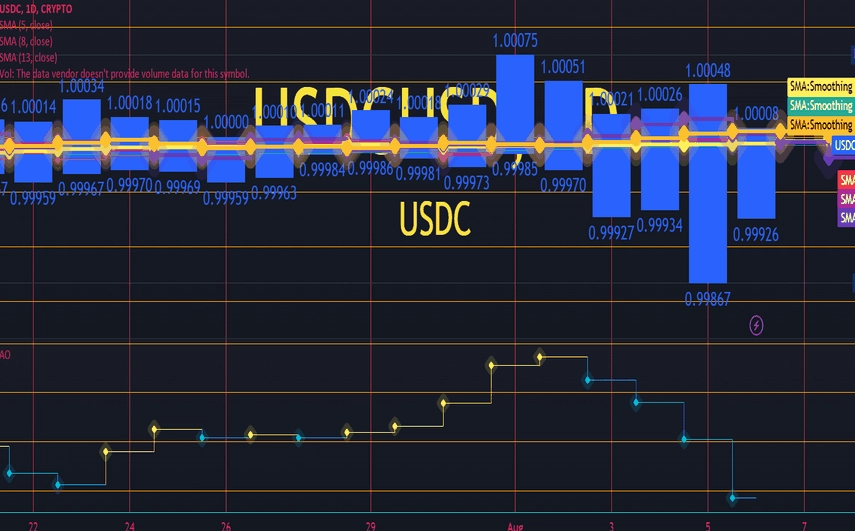
News and Sentiment
While USDC has a strong reputation, negative news about its issuer Circle, its partner banks (like the Silicon Valley Bank incident in March 2023), or broader regulatory crackdowns on stablecoins can cause temporary de-pegging due to panic selling. It usually recovers quickly if the fundamentals are sound, but that window creates volatility.
How to Trade USDC: Strategies for Beginners and Pros
You don't just "trade" USDC like a volatile coin. You use it as a tool. Here’s how.
The Parking Strategy: This is the most common use. Selling Bitcoin or Ethereum into USDC during market uncertainty locks in your value in a ~$1 asset. It's not profit-taking; it's risk management. The key is to do this on an exchange where you can easily move back. Don't park it on a platform with high withdrawal fees.
The Simple Arbitrage Play: This is for the observant. If you see USDC trading at $0.998 on Exchange A and $1.001 on Exchange B, you could theoretically buy low on A and sell high on B. In practice, transfer fees and speed kill this for small amounts. But it's the principle that keeps the global price aligned.
The DeFi Yield Engine: This is where USDC gets interesting. Holding USDC in a bank gets you nothing. Holding it in a reputable DeFi lending protocol like Aave or Compound can earn you 2-5% APY, paid in more USDC. Your principal stays pegged, and you earn yield on it. The risk shifts from market volatility to smart contract risk.
Let me give you a specific scenario. Say you have $10,000 in crypto and fear a downturn. You swap to USDC on Coinbase. Then, you bridge that USDC to the Polygon network (lower fees). You deposit it into Aave on Polygon as collateral, and you borrow a small amount of MATIC against it (say $1,000 worth) to pay for future transaction fees. Your USDC is now earning yield while sitting as your "safe" base, ready to be redeployed. This is a basic but powerful active holding strategy.
USDC vs. USDT: A Price Stability Comparison
No discussion is complete without comparing it to Tether (USDT). Both aim for $1, but their paths are different.
Transparency: USDC wins, hands down. Monthly, detailed attestations vs. Tether's quarterly reports with less granularity. For a risk-averse user, this matters.
Track Record Under Stress: During the March 2023 banking crisis, USDC briefly de-pegged to $0.87 due to exposure to Silicon Valley Bank. It restored the peg within days after Circle assured coverage. USDT, during various controversies over the years, has seen smaller but more frequent wobbles. USDC's de-pegging was sharper but driven by a specific, resolvable event.
Ecosystem Preference: USDT dominates on exchanges for trading pairs, especially outside the US. USDC is the darling of DeFi and institutional protocols. Many new DeFi projects default to USDC as their stablecoin of choice because of its perceived regulatory compliance and transparency.
My take? For long-term holding or as collateral in complex DeFi positions, I lean towards USDC for its audit clarity. For quick trading on spot markets, I'll use whatever pair has the most liquidity (often USDT). Diversifying across stablecoins isn't a crazy idea.
The Future of USDC Price: Challenges and Innovations
The $1 peg faces future tests. Regulation is the big one. The U.S. is moving towards legislation that could mandate 1:1 cash and Treasury backing, banning commercial paper. This would actually solidify USDC's model but could change its yield profile for the issuer.
Technical innovation also plays a role. USDC is expanding to dozens of blockchains (Solana, Base, Arbitrum, etc.). The price needs to stay synchronized across all of them. Cross-chain bridges have been hacked before, leading to temporary price chaos on one chain while the main Ethereum peg held steady.
The rise of algorithmic stablecoins (despite UST's collapse) and interest-bearing native stablecoins will challenge the simple "1 USD in a bank for 1 token" model. USDC's price stability will remain its core selling point, but to stay dominant, it may need to integrate yield features at the protocol level.
Reader Comments